
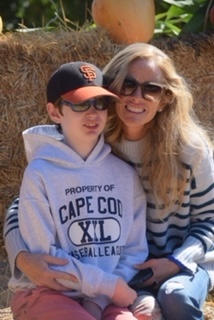
In her memoir, Fault Line Boy, Parker recounts her family’s journey through a world of emergency rooms, medical specialists, and fragile hope after her youngest son’s diagnosis of pediatric epilepsy. Her essay here touches on what prompted her to tell her story to others and the challenges of writing a medical memoir when circumstances constantly change. To find out more about Parker and her book, visit jenmurphyparker.com.
When my youngest son, Lew, was diagnosed with severe epilepsy at two years old, I was devastated, but not surprised exactly. I’d come to motherhood knowing and fearing something could go wrong. I’d curated a collection of concerns—untrustworthy umbilical cords, extra chromosomes, cells that got division-happy, overdid it, and ruined bodies.
I’d worried so much. I now worried I’d somehow manifested Lew’s disorder. That my catastrophizing had caused his catastrophic epilepsy, my thoughts sneaking into his DNA and truncating his sodium channel, causing the mutation that would sentence him to a lifetime of seizures and cognitive disabilities.
It wasn’t rational, but at the time, nothing made sense, least of all a perfectly healthy-looking baby short-circuiting on an hourly basis. We lived with a perpetual and relentless threat; our life frozen still despite my son’s constant shaking.
And as I dealt with the infinity of Lew’s epilepsy, I faced the scariest truth of all: It could be finite. Endings were always possible. And though a rare epilepsy is a specific and terrible disease, it also amplifies the fears and instabilities that prove universal in parenthood.
I started writing my memoir Fault Line Boy to make sense of our family’s sudden and complete unsteadiness, to find a way in our new world of specialists, pharmaceuticals, ambulance rides, and hospital stays. I didn’t have an outline—severe epilepsy wouldn’t allow it. Severe epilepsy doesn’t allow for plans of any kind. It’s a plan ravager, in fact.
Lew’s first seven years felt hopeless, as if his health would never improve, as if his life would be compromised and unhappy and possibly too short. Until a clinical trial drug worked. Lew has now had one seizure in nine years. An outcome born of science and called a miracle.
His life and his story transformed, as did my telling of it.
Now early chapters of Fault Line Boy, just like Lew’s early chapters, feel like they’re about another kid. The through line from that Lew to present-day Lew is barely visible, perhaps the only trace is his relentless delight and joy in the world, there from the start. Because Lew was born ready to live a happy life, something that—thanks to an excellent doctor, science, and luck—got a whole lot easier back in 2017.
Of course, a medical memoir seems to present a final outcome. But Lew’s story continues, and a medical memoir is only ever a snapshot. Nothing about life is static, least of all health. Lew isn’t cured; he is stabilized by a small-pharma wonder drug, a drug that’s allowed him to live fuller days than we ever could’ve imagined when he was first diagnosed.
But he is only ever as good as his last hour. Just like any one of us.
And no one’s taught me more about living deeply in each hour than Lew.

